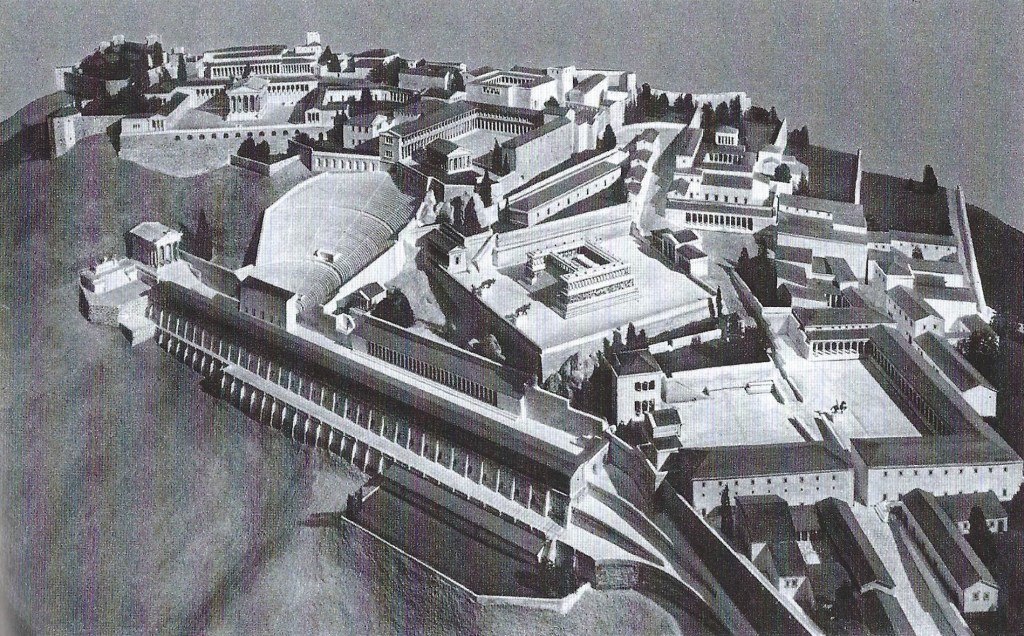
In Pergamon, as in other capitals of Hellenistic kingdoms, a permanent theater adjoined the royal palace, so that the people gathered on its terraces could seamlessly attend plays featuring gods and mythical characters, as well as spectacular speeches and stagings by its rulers, who themselves claimed to be of divine descent.
“It has long been observed that the theater occupied a central position in the urban planning of Hellenistic royal capitals. The formula of juxtaposing the royal palace and the theater, attested in Agai, the ancient Macedonian capital, as well as in Alexandria, found its most striking expression in Pergamon. The Attalid acropolis fanned out its monuments around the crater of a vertiginous theater built into the side of its cliff. Above the terraces, the sanctuary of Athena Nicephoros (“who bears victory”) preceded the royal palatial complex, a residential building erected next to a sumptuously ornamented edifice reserved for receptions.
The purpose of this bold design was undoubtedly to exalt the charismatic power that these kings derived from their alleged heroic ancestry, which they traced back to Heracles through the intermediary of his son Telespheus. The people gathered in the theater to attend tragedies that brought the heroes of the Trojan War back to life before their very eyes, on the slopes of an acropolis where their kings seemed to regain the closeness between gods and heroes sung by Homer and the Tragics.
An episode reported by Plutarch illustrates the purpose of such urban planning. At the time of his bloody revolt against the power of Rome, the king of Pontus, Mithridates VI Eupator, had gathered the population of the recent province of Asia inside the theater of Pergamon, and had sought to be crowned by a mannequin with the appearance of Victory who had been lowered from the top of the building with the help of some machinery (Plutarch, Sylla, 11, 1-2). Although Plutarch does not say so, it is clear that this “Victory” came from the sanctuary of Athena Nikephoros, the goddess to whom the kings had attributed their military successes.
This kind of staging of power inside theaters is characteristic of the Hellenistic period, all the more so as the Dionysian technite associations (technitai, i.e. “artists”), which were vast, structured guilds of musicians and actors, played a major role in the celebration of royal cults, particularly those of the Attalid dynasty.”
(Gilles Sauron, La peinture allégorique à Pompéi – Le regard de Cicéron, Picard, 2007, p. 48 – our translation)
